
EXHIBITX BLOG
11,000 Messages, 3 Weeks, and the 47 That Will Decide Custody
11,000 Messages, 3 Weeks, and the 47 That Will Decide Custody
A family law attorney in our network recently received a discovery production from opposing counsel: fourteen months of text messages between two divorcing parents. The export landed in her inbox as a 600-page PDF.
Her hearing was in three weeks.
She needed to find the messages about the DUI scare. The ones where her client's ex admitted he hadn't refilled their daughter's inhaler. The thread where he asked her to delete their conversation. She knew those messages were in there — her client had read them to her over the phone, voice shaking — but finding them inside 11,000 messages, organizing them into a coherent legal narrative, and citing them precisely in a motion? That was a different problem entirely.
It's the problem family lawyers face every week. And it's getting harder.
Text Messages Are Now the Primary Evidence in Family Law
Walk into any family law hearing today and you'll see it: exhibits printed from phones, screenshots blown up on courtroom screens, opposing counsel reading texts aloud into the record. Text message evidence has become central to custody disputes, support modifications, and restraining order proceedings in a way that would have been unimaginable fifteen years ago.
The reason is simple. People say things in text messages they would never say in an email. They're informal, immediate, and — crucially — people forget they're creating a record. A parent who would never write "I've been drinking, don't tell your mom" in an email will absolutely send it in a text at 9:30 on a Tuesday night.
The problem isn't finding the evidence. The problem is managing it.
Text message exports arrive as unstructured data dumps. A year of communication between two parents might span thousands of messages across iMessage threads, WhatsApp, and co-parenting apps — mixed together, timestamp-sorted if you're lucky, covering everything from Ellie's soccer practice schedule to late-night arguments about money. Critical admissions sit next to grocery lists. The message where your client's ex admits he drove their daughter home after drinking is surrounded by 200 messages about Thanksgiving logistics.
Manual review of this volume takes 20 to 40 hours. Most firms don't have that time. Most clients can't afford it. And even when attorneys do read through everything, human review misses patterns — the fact that a parent was late to custody exchanges eleven times in eight months only becomes visible when you've catalogued every single exchange date and time.
What a Year of Texts Between Two Parents Actually Contains
Consider Mark and Nina, divorcing parents of eight-year-old Ellie. Their separation has been contentious. Nina retained counsel six months in; Mark followed two months later. By the time discovery begins, their text thread covers fourteen months and roughly 11,200 messages.
On the surface, it looks like the communication record of any difficult co-parenting relationship: scheduling, school logistics, arguments about money, occasional warmth around their daughter's milestones. But buried in that thread are nine distinct categories of evidence — each legally significant, each requiring different treatment in litigation.
Direct admissions. These are the messages family lawyers dream about. In the Mark/Nina thread, there are several. In response to Nina's question about why he hadn't reported a side income to the mediator, Mark writes: "Not if it's cash, they can't prove it anyway." Three months later, responding to Nina's concern about him drinking: "I had like 2 beers, relax. Ellie was asleep." These messages are unambiguous. The challenge is finding them.
Pattern evidence. Single incidents are easy to explain away. Patterns are not. A careful review of the Mark/Nina thread reveals that Mark returned Ellie late from his custody time on eleven separate occasions over eight months — sometimes by twenty minutes, twice by more than two hours. No single message establishes this. But the pattern, reconstructed from timestamps and exchange confirmations, tells a story about reliability that a judge can't ignore.
Contradictions. Mark's sworn financial affidavit states his landscaping business "barely covers overhead." His texts tell a different story. In a message to Nina two months before filing, he writes that the business "needs to cover payroll this week" — an odd statement for a sole proprietor with no employees, if the business is as struggling as he claims. A later message references "the payment from the Henderson job" in a context suggesting cash. Cross-referencing these texts against his disclosed financials creates a contradiction that goes directly to credibility.
Consciousness of guilt. This is perhaps the most damaging category. At one point in the thread, after a heated argument about the financial disclosure, Mark sends: "Look, can we just delete this stuff about the cash? I don't want it coming up." Nina did not delete anything. That message — a direct attempt to suppress evidence — is now an exhibit. Courts treat requests to destroy evidence seriously, and the fact that it came in a text message makes it harder to contextualize as anything other than what it appears to be.
Best interest factors. Courts in custody disputes apply a best interest of the child standard. The text record contains direct evidence on this question. There are messages where Mark discusses Ellie's schedule with warmth and attentiveness. There are also messages where he forwards Ellie communications from her school rather than handling them himself, messages where Nina has to remind him three times to schedule a pediatric appointment, and a thread about a missed inhaler refill that shows Ellie went to school with an empty rescue inhaler for four days while Mark was on a camping trip with his new girlfriend.
Parental alienation. Several messages show Mark making disparaging comments about Nina directly to Ellie — or describing conversations with Ellie about Nina's "bad attitude." Courts take a dim view of parents who put children in the middle of adult disputes, and the text record documents a pattern of this behavior across multiple months.
What Lawyers Currently Do With This Volume
The honest answer: they cope.
The standard workflow for text message review in family law looks something like this. A paralegal exports the messages, converts them to PDF, and drops them in a shared folder. The attorney opens the PDF, runs Ctrl+F for obvious keywords — "drink," "money," "late," the other parent's name — and flags matches with sticky notes or a separate document. Important messages get screenshot and printed. The attorney reads through the flagged sections and drafts a summary of what they found.
This workflow has real problems.
First, it misses everything you didn't know to look for. Ctrl+F finds "drink." It doesn't find "I had a couple" or "just one" or the absence of any message during a weekend when your client suspected her ex was using. Pattern detection requires reading chronologically, keeping mental notes across thousands of messages — a cognitive task that humans perform poorly under time pressure.
Second, it doesn't cross-reference. The text message that contradicts the sworn affidavit is only useful if you know what's in the sworn affidavit. Manual review treats the text thread as an isolated exhibit, not as one layer in a multi-document record.
Third, it's expensive. Twenty hours of attorney time reviewing a text export — at $350 per hour — is $7,000 in legal fees before a single motion is drafted. Many family law clients are already financially strained by the divorce itself. This work often goes undone, or gets done partially, or falls to less experienced staff who may not know what they're looking for.
Fourth, and most consequentially, it produces a record that doesn't hold up in hearings. Vague references to "numerous text messages" showing a pattern carry far less weight than a specific citation: "On fourteen occasions between March and November, as documented in Exhibits 47 through 61, Respondent failed to return the minor child at the agreed exchange time." The first is an allegation. The second is evidence.
How an Exhibit Index Changes Everything
An exhibit index built from a text message thread isn't just an organized version of the same work. It's a fundamentally different product.
When ExhibitX processes the Mark/Nina thread, it doesn't read sequentially and flag keywords. It analyzes the entire corpus simultaneously, categorizes messages by legal issue, reconstructs timelines, identifies patterns, and surfaces contradictions — then presents findings in a structured, citable format.
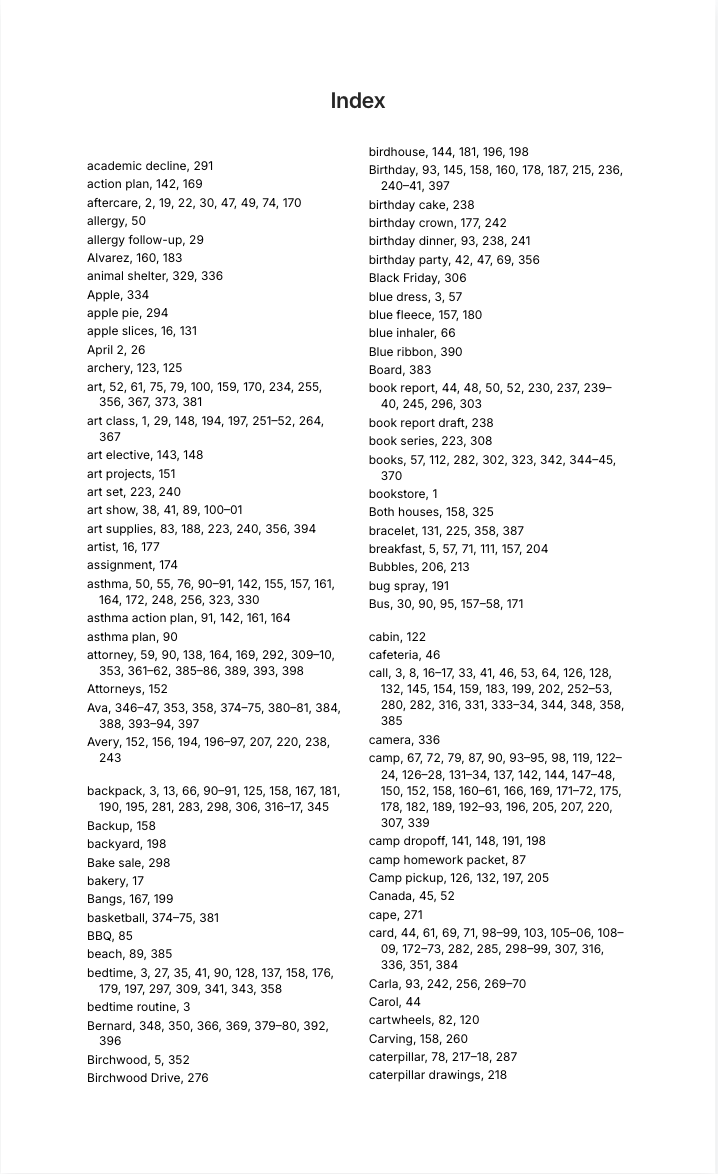
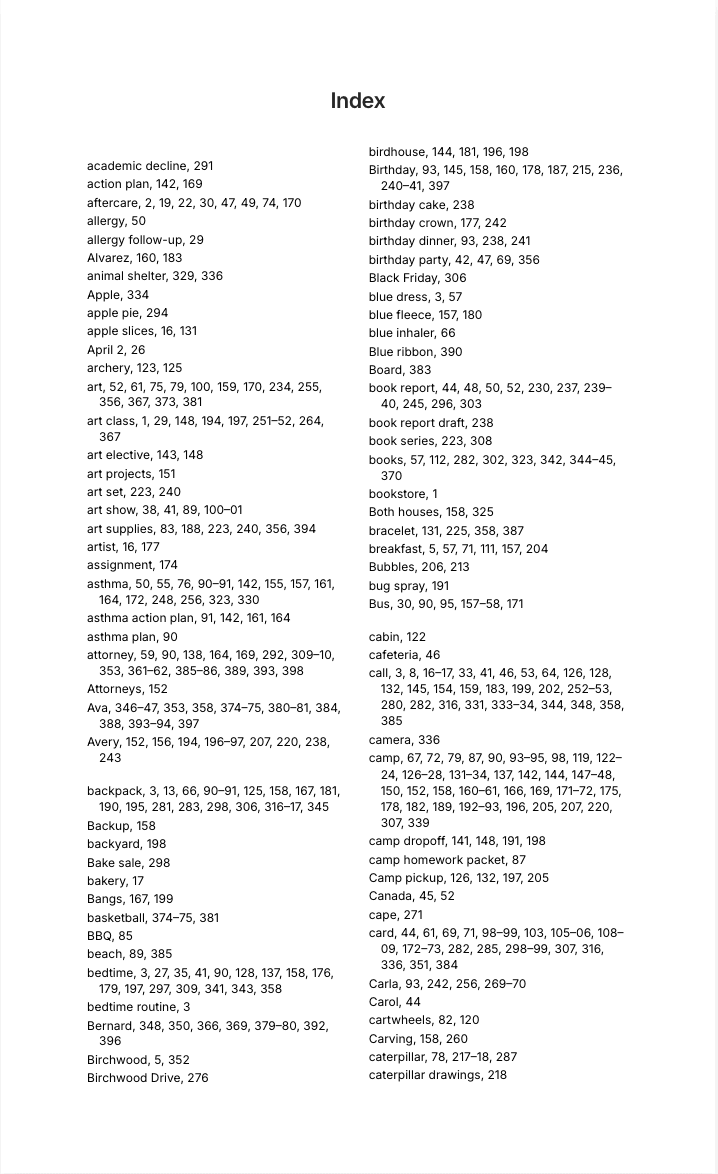
Download the full indexed custody text messages (PDF) — the complete ExhibitX-generated index for the 600-page text message production.
Here's what that looks like in practice.
Categorization by legal issue. Every message gets tagged to the relevant legal categories: custody compliance, financial disclosure, safety, parental conduct, child wellbeing. A message about the inhaler gets tagged to both medical negligence and child safety. Mark's message about deleting texts gets flagged under evidence spoliation. The attorney can filter by any category and see every relevant message — nothing is buried under grocery lists.
Timeline reconstruction. Custody violation patterns become visible automatically. The system identifies every exchange date, every message confirming or explaining a late return, and every gap where a confirmation never came. What took a paralegal four hours now takes seconds: Mark was late to custody exchanges on eleven occasions between March and November, the average delay was 47 minutes, and the two longest delays — three hours and two hours forty minutes — both occurred on weekend returns following holiday periods.
Contradiction flagging. When Mark's text references covering payroll sits next to his financial affidavit statement about the business barely covering overhead, the system surfaces both. The attorney doesn't need to hold the affidavit in one hand and the text export in the other, manually comparing claims. Contradictions are identified and annotated.
Key admission extraction. Direct admissions — the messages where a party says something they clearly shouldn't have — are surfaced as a separate category. Not because they contain a specific keyword, but because the content of the message, read in context, constitutes an admission against interest. "Not if it's cash" is extracted. "I had like 2 beers, relax" is extracted. "Delete this stuff" is extracted. The attorney sees these first, before anything else.
Four Searches That Change a Case
Abstract descriptions of indexing capability are less useful than concrete examples. Here are four specific scenarios from the Mark/Nina dispute and what an exhibit index produces.
"Find every instance where Mark acknowledged drinking around Ellie."
Manual search: Ctrl+F for "drink," "beer," "drunk," "alcohol." Review 23 hits. Most are references to wine at dinner with no mention of Ellie. Three are relevant. Maybe miss two more that use "had a couple" or "grabbed a few."
Exhibit index result: Six messages, chronologically organized, with excerpts and timestamps. Two direct admissions ("I had like 2 beers, relax. Ellie was asleep."). One ambiguous message that, read in context of the thread, references drinking before a school pickup. One message where Mark tells Nina "we just had a drink after dinner, no big deal" on a night when Ellie was with him. The attorney sees all six. She didn't know to search for "no big deal."
"Show all custody schedule violations in chronological order."
Manual search: Read the entire thread. Note each late return. Build a spreadsheet. Two to four hours of paralegal time.
Exhibit index result: A timeline of every scheduled exchange date, every confirmation message, every late-return message and the stated reason, every instance where no confirmation was ever sent. Eleven violations documented. Eight include a message from Mark explaining the delay. Three include no acknowledgment that he was late at all — which is its own kind of evidence.
"Flag all financial contradictions between the texts and the sworn affidavit."
Manual search: Requires holding both documents simultaneously, reading the affidavit line by line, then searching the text export for anything that addresses the same claim. Highly dependent on attorney experience. Likely misses several.
Exhibit index result: Cross-reference between the sworn financial disclosure and the text corpus. Five contradiction candidates identified: the payroll reference, a mention of a cash job in September, a message asking Nina not to mention "the Henderson account" in any filings, a text where Mark tells his brother the business had a "strong Q3," and a reference to a new truck purchase two weeks after claiming the business was operating at a loss.
"Extract every message where Ellie's wellbeing was directly at issue."
This is the search that matters most in a best interest analysis — and it's the one that's nearly impossible to run manually. It doesn't have keywords. It requires understanding context.
Exhibit index result: 34 messages flagged across seven subcategories: medical decisions, school attendance, emotional wellbeing, physical safety, schedule disruption, parental conflict witnessed by child, and parental attentiveness. The attorney now has the raw material for a best interest analysis grounded in specific documented incidents rather than her client's subjective account.
How Organized Evidence Changes Outcomes
The value of an exhibit index isn't just efficiency. It changes the quality of legal work product and, by extension, outcomes.
Motions become more powerful. A motion for modification that cites "Exhibit 47, text message dated October 14 at 7:43 PM, in which Respondent states 'I had like 2 beers, relax, Ellie was asleep'" is categorically different from a motion alleging "Respondent has been observed drinking around the minor child on multiple occasions." The first gives a judge something to act on. The second invites a credibility contest.
Hearings move faster. Judges in family law courts are managing heavy dockets. When counsel can hand up a clean exhibit index — organized by issue, with specific citations, cross-referenced across documents — it signals competence and saves the court time. Judges notice. More practically, organized evidence allows direct examination to move efficiently through specific incidents rather than relying on a witness to reconstruct months of events from memory.
Settlement leverage improves. Opposing counsel's calculus changes when you can show them, specifically, what you have. A vague claim that "the texts are bad" invites negotiation. Showing opposing counsel a four-page summary of direct admissions, contradiction flags, and a documented pattern of eleven custody violations tends to move settlement discussions in a different direction.
Client costs go down. The attorney in our example spent 22 hours on text message review before this workflow existed. With an organized index, that drops to under four hours — reviewing the index output, verifying key exhibits, and drafting the motion. At $350 per hour, the savings to her client were over $6,000 on a single phase of discovery. For a family law client managing divorce costs alongside everything else, that's not a minor consideration.
The Evidence Is Already There
Mark sent those messages. The request to delete the cash texts, the admission about the beers, the message about payroll — all of it exists, timestamped and authenticated by metadata that will hold up in court. Nina's attorney's job isn't to create evidence. It's to find it, organize it, and present it in a form the court can use.
The gap between "the evidence exists" and "the evidence is usable" is where family law cases are won and lost. A 600-page PDF of 11,000 text messages is not usable evidence. It's a data problem. An exhibit index that organizes those messages by legal issue, reconstructs the custody violation timeline, flags the financial contradictions, and extracts the direct admissions — that's usable evidence.
The hearing is in three weeks. The messages are already there.
The question is whether you can find the 47 that matter before opposing counsel finds theirs.
ExhibitX helps family law attorneys transform unstructured document exports — text messages, emails, PDFs — into organized, citable exhibit indexes. Learn more at exhibitx.ai.