
EXHIBITX BLOG
Indexing the Fed's Beige Book: how to actually use a 50-page economic report
Eight times a year, the Federal Reserve publishes the Beige Book — a qualitative snapshot of economic conditions across all 12 Federal Reserve Districts. It's compiled from interviews with businesses, community organizations, economists, and market contacts. No single government publication offers a more ground-level view of the American economy.
The April 2026 edition runs over 50 pages. It covers Boston, New York, Philadelphia, Cleveland, Richmond, Atlanta, Chicago, St. Louis, Minneapolis, Kansas City, Dallas, and San Francisco. Each district report follows a roughly similar structure — economic activity summary, labor markets, prices, consumer spending, manufacturing, real estate, banking, and often agriculture, energy, or community conditions — but the details are entirely district-specific.
The result is a document that's rich with signal and difficult to search. The same topic — say, the impact of rising energy costs — appears in 12 different contexts with 12 different sets of anecdotes and observations. If you're trying to build a picture of how a single economic force is playing out across the country, you're reading 50 pages and taking notes by hand.
Unless you index it.
What the Beige Book actually contains
The Beige Book is unusual among financial documents. It's not a data release. It doesn't contain tables of numbers or statistical exhibits. Instead, it's a narrative document — thousands of sentences describing what the Fed's contacts are seeing on the ground.
The April 2026 edition captures an economy navigating several crosscurrents simultaneously:
- The conflict in the Middle East appears in virtually every district report. Energy costs are surging. Fuel surcharges are spreading. Manufacturers are absorbing higher input costs. Shipping contacts are warning about supply chain disruptions. Contacts in Cleveland describe fuel costs as "skyrocketing." A jeweler in Williamsburg, Virginia tells the Richmond Fed that online shopping is killing foot traffic — "it's been my worst year so far." Food banks in New York report long lines as utility bills outpace incomes.
- Tariff uncertainty compounds the energy picture. Manufacturers across multiple districts report difficulty forecasting business performance due to unpredictable import costs. Philadelphia contacts cite tariffs and the Middle East conflict as their two greatest challenges. In Richmond, a business says continuing higher tariff rates are "simply unsustainable for our business."
- AI's quiet labor market impact surfaces in several districts. New York reports high demand for finance professionals and tech workers with AI skills, while AI simultaneously reduces demand for entry-level workers. Boston and Cleveland note AI-driven productivity improvements that enabled firms to delay or reduce hiring. Atlanta contacts report AI has already replaced some head count.
- Consumer financial strain appears alongside resilient high-end spending. Multiple districts describe a bifurcation: lower and middle-income consumers trading down, visiting food banks, shifting from cash to credit cards — while luxury real estate, high-end retail, and wealth management hold strong.
- Data center demand drives commercial real estate and energy activity in nearly every region, from New York's office market to Cleveland's manufacturing sector to Atlanta's industrial demand.
None of these themes are contained within a single section. They're woven across 12 district reports, each telling the same story from a different angle.
The problem with reading the Beige Book
The Beige Book is organized geographically, not thematically. Each district gets its own four-to-six-page section. If you want to understand what's happening with manufacturing nationally, you read twelve separate manufacturing subsections. If you want to track how energy prices are affecting consumer spending, you piece it together from passing references in Boston, explicit analysis in Cleveland, anecdotes in Richmond, and data points in Chicago.
Financial professionals who use the Beige Book — equity analysts, fixed income traders, macro strategists, economists — don't read it like a novel. They read it like a reference document, hunting for specific signals:
- Is the Fed seeing wage pressure accelerate or moderate?
- Which sectors are absorbing input cost increases versus passing them through?
- Where are credit conditions tightening?
- How are contacts characterizing the six-month outlook?
These questions cut across every district. Answering them from a PDF means twelve rounds of scanning, highlighting, and cross-referencing. It's the kind of work that takes an analyst an hour and still leaves gaps.
What an index makes possible
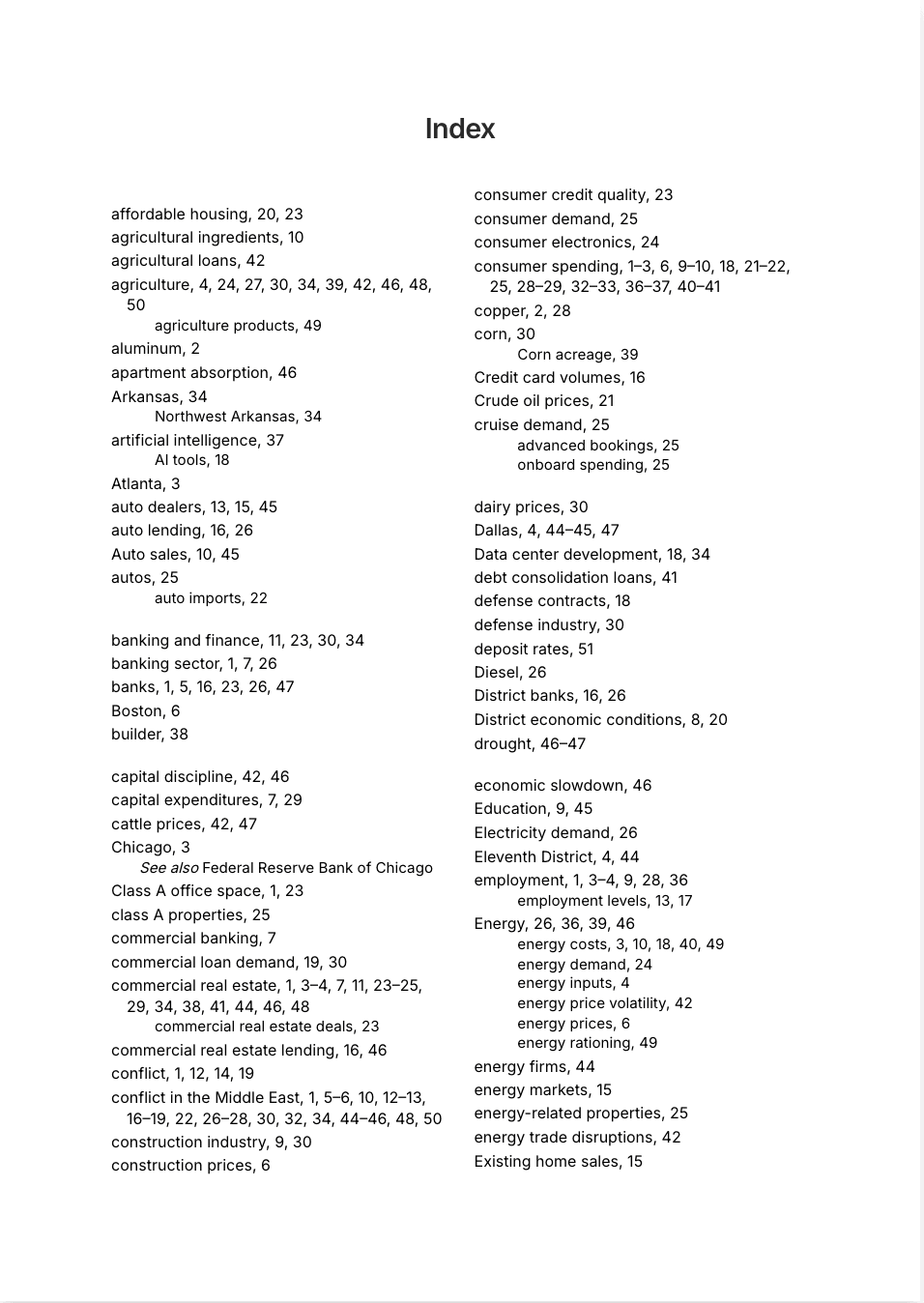
When you feed the Beige Book into ExhibitX, the platform extracts every entity, concept, and economic indicator across all 50 pages — then maps where each one appears and in what context.
The result is a structured, searchable index of the entire document. Every extracted term links back to the exact passage where it appears in the original text.
We used the following custom instruction to guide the index:
Extract economic indicators and conditions by Federal Reserve District, including labor market signals (hiring, layoffs, wage pressure, skilled worker shortages), price and inflation references (input costs, fuel, tariffs, pass-through), consumer spending patterns, credit and lending conditions, real estate activity (residential and commercial), sector-specific observations (manufacturing, agriculture, energy, data centers), geopolitical factors (Middle East conflict, trade policy), sentiment language (outlook characterizations like "cautiously optimistic" or "deteriorated"), and named entities (cities, industries, organizations cited by contacts).
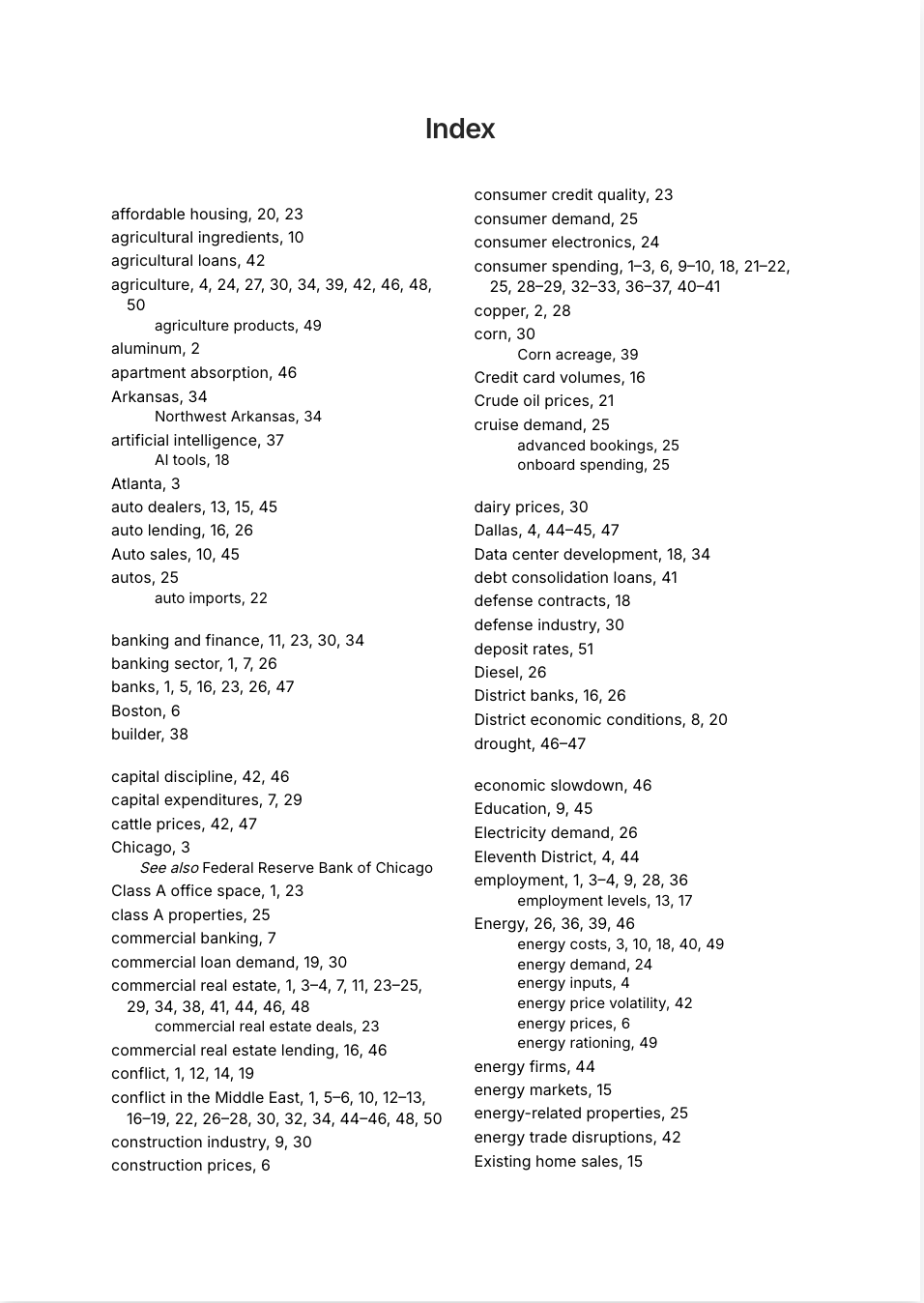
Download the full indexed Beige Book (PDF) — the complete ExhibitX-generated index for the April 2026 edition.
Here's what changes:
Cross-district comparison becomes instant
Search for "data centers" and you see every reference across all 12 districts in a single view: Cleveland manufacturing contacts reporting it as a primary demand driver, Philadelphia construction focused on data center and healthcare projects, Richmond noting data center land prices exceeding $4 million an acre, Atlanta citing data center demand as a source of industrial strength, and Chicago seeing electricians commanding premium wages from data center developers.
That's a national picture of data center-driven economic activity assembled in seconds — something that would take 15 minutes of careful reading to compile manually.
Anecdotes become retrievable
The Beige Book's power lies in its anecdotes. These aren't statistics — they're direct observations from people running businesses, managing portfolios, and operating nonprofits. But anecdotes are the hardest thing to relocate in a long document. You remember reading about a restaurateur describing wage decisions as "an incredible mixed bag," but which district was that? What section?
An index makes every anecdote findable. The Strait of Hormuz closure and its impact on fertilizer prices. The food pantry operator in New York describing long lines and high demand. The upstate New York wood mill struggling to find workers for physically demanding jobs. The Providence-area developer held back by high taxes and proposed rent control. Each one is a term in the index, linked to its source.
Sentiment tracking across districts
The Beige Book is the closest thing the Fed publishes to a sentiment survey, but it's delivered in prose rather than numbers. The language varies: "cautiously optimistic" in St. Louis, "deteriorated" in Dallas, "expected little improvement" in New York. An index surfaces these characterizations as searchable terms, letting you scan the range of outlooks without reading every summary paragraph.
This is particularly valuable for the April 2026 edition, where outlook language varies dramatically. Some districts report contacts who are "attentive to risks" but fundamentally optimistic. Others describe a "fog of uncertainty" or outlooks that "deteriorated amid elevated geopolitical uncertainty and fuel price concerns." An index lets you see that divergence at a glance.
Economic indicators become navigable
Even though the Beige Book is qualitative, it's packed with specific economic signals: mortgage rates dipping below 6 percent then rising back over 6.5 percent, nonperforming loans edging up, credit standards tightening, H-2A wage rates declining, capacity utilization constrained at 82 percent of surveyed firms. These aren't headline numbers — they're details embedded in dense paragraphs that are easy to skip on a first read and impossible to find on a second.
An index treats each of these as a navigable entry point rather than a needle in a haystack.
Who uses the Beige Book — and why indexing helps
Equity analysts and portfolio managers
The Beige Book is a leading indicator — qualitative observations that often precede the data by weeks or months. Analysts reading for sector signals need to compare what contacts in multiple districts are saying about the same industry. An index organizes those signals by topic rather than geography, cutting research time dramatically.
Fixed income and rates traders
Every Beige Book is published two weeks before an FOMC meeting. Rates traders parse it for clues about the Fed's likely posture — is the economy running hotter or cooler than expected? Are contacts seeing inflation pressures build or moderate? An index surfaces every price-related reference, every mention of credit conditions, every characterization of the economic outlook in one place.
Economists and policy researchers
Researchers studying regional economic divergence or the transmission of supply shocks need to compare the same category across districts. The Beige Book's geographic structure makes this tedious. An index reorganizes the same material thematically, making it immediately useful for comparative analysis.
M&A and corporate attorneys
Due diligence on a transaction often involves understanding the economic environment in a specific region or industry. The Beige Book is a primary source for that context — but only if you can quickly extract the relevant passages. An attorney preparing for a deal in the Sixth District doesn't need the full Atlanta section; they need every reference to the specific sectors and conditions affecting the transaction.
Journalists and researchers
Reporters covering the economy mine the Beige Book for quotes, anecdotes, and regional color. An index turns the document into a source database — searchable by topic, district, or specific language.
The broader case for indexing financial documents
The Beige Book illustrates a challenge that's common across financial documents: important information distributed across a rigid structure that doesn't match how people actually need to use it.
Earnings transcripts follow a similar pattern — relevant information about pricing, demand, or capital allocation scattered across prepared remarks and analyst Q&A. Regulatory filings bury material disclosures in standardized sections. Research reports spread a thesis across 30 pages of narrative and exhibits.
In each case, the document's structure serves the producer, not the reader. A geographic organization makes sense for the Fed's internal process — each Reserve Bank reports on its own district. But the people who consume the Beige Book need to cut across that structure, not follow it.
An index is the bridge. It preserves the original document while adding a navigational layer that reflects how the reader actually thinks: by topic, by entity, by economic concept. No summarization, no interpretation — just a way to find what you need and read it in its original context.
The Beige Book is published eight times a year. The next one is always coming. Having a way to index it — and compare indexed editions over time — turns a bimonthly reading assignment into a searchable, accumulating body of economic intelligence.
ExhibitX is an AI-powered document indexing platform. Upload any document — PDFs, earnings transcripts, regulatory filings, research reports — and get a structured, searchable index in minutes. Try it free.